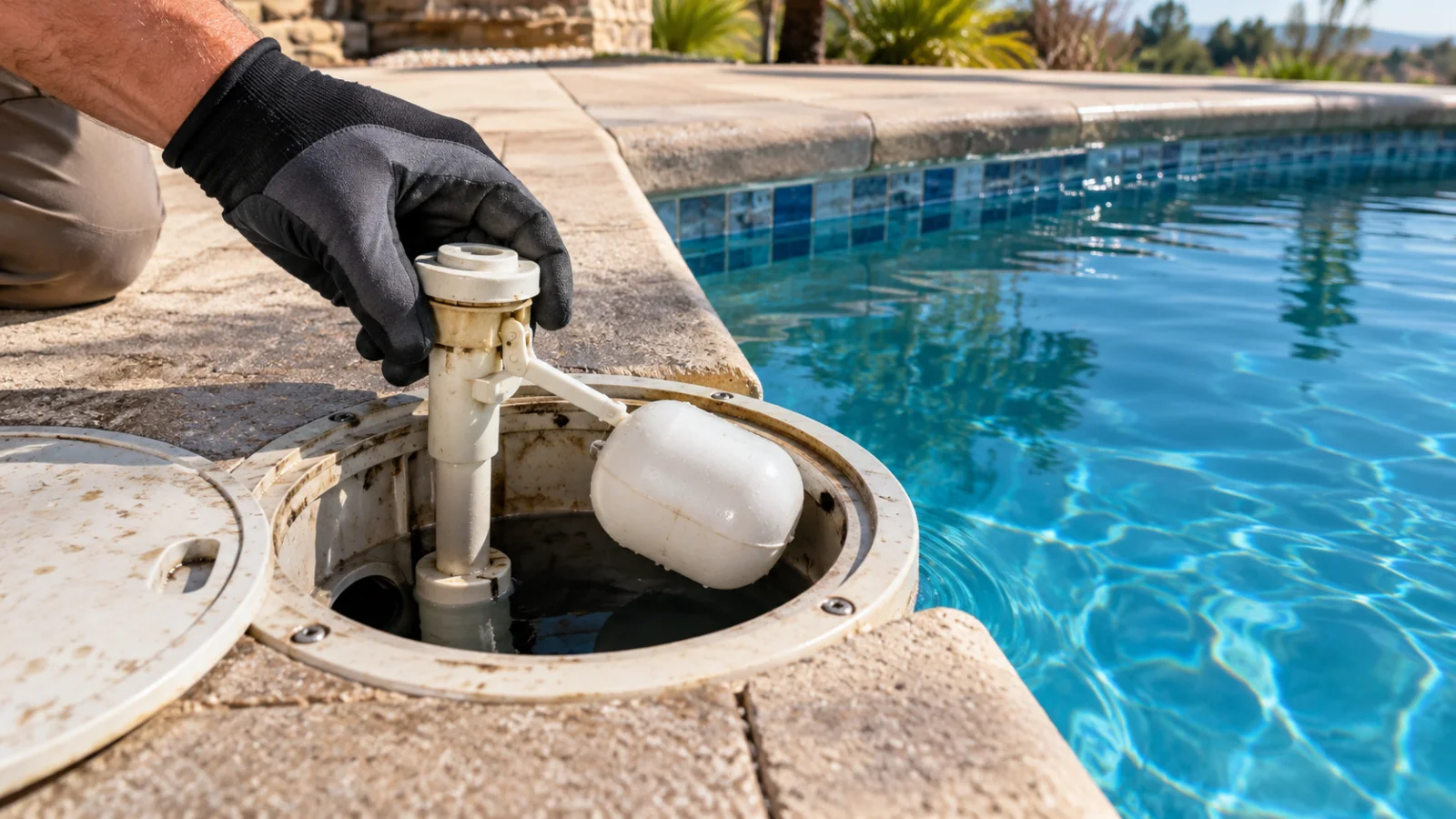
A rising waterline can make a pool look like it has a hidden plumbing problem. When a pool auto-fill is stuck on, the first task is confirming that fill water is still entering. Then a licensed pool pro can separate a failed leveler from a real leak or another water source.
Auto-fill stuck open versus a real leak
A pool autofill not shutting off can hide the pool’s normal water movement. The waterline may remain steady because incoming water replaces water escaping elsewhere. It may also climb because the filler itself never closes. Those symptoms require different repairs.
Start with observations, not adjustments. Note the waterline against a fixed tile or another stable reference. Record recent rain, any hose use, and whether water is visibly entering through the fill outlet. Don’t keep changing the target level while you’re gathering that information.
If you know the dedicated fill-water shutoff and can reach it safely, closing it can control the incoming water. Don’t guess among irrigation, household, or pool circulation valves. Ask a licensed pro to identify the correct control if it isn’t documented.
Owners of a Paramount Paralevel have a manufacturer-specific check. Paramount says to lift the float and see whether water flow stops. If it doesn’t, Paramount directs the owner to turn off the water supply and inspect the product according to its instructions. That procedure applies to Paralevel equipment. It isn’t a universal test for every mechanical or electronic leveler.
Once incoming fill is stopped, watch the waterline under comparable conditions. Our guide to pool leaks versus evaporation in San Diego explains how to record a useful pattern. A float test alone can’t prove that the pool shell and underground plumbing are sound.
Float valves, saddle tees, and the fill line
A pro first identifies the installed level-control system. Some accessible chambers contain a mechanical float. Other pools use electronic controls and a controlled water valve. A round deck lid doesn’t confirm what’s beneath it.
For a Paralevel, Paramount’s published guidance focuses on the float, its O-ring, and a small orifice. The manufacturer says an owner should call a pool builder or pool professional if its listed checks don’t correct the problem. Those details shouldn’t be applied to another brand without its manual.
The water source matters just as much as the level-control part. A licensed pro traces the fill line and identifies its actual shutoff. The pro also checks how the line was connected. If someone describes a connection as a saddle tee, that label still doesn’t establish its condition or show which valve controls it. The installed parts need direct inspection.
Avoid copying a generic replacement procedure from another system. Thread type, valve design, adjustment method, and approved replacement parts can differ. Bring any installation records to the visit. A readable model label and photos of the chamber can also help.
Ask the pro to document the dedicated fill shutoff after identifying it. Keep that information with the pool equipment records. It gives you a known control if the filler runs again.
For repair work, Refresh Pool Pros can connect you with a licensed specialist through our pool repair service. You can also check a contractor directly through the CSLB license lookup.
Standing water on the pad and a climbing water bill
Continuous fill water can show up in more than one place. The pool may rise above its usual tile reference. Water may appear near the leveler chamber or along the supply route. A bill may also change, although the bill alone can’t identify which fixture used the water.
Compare current use with your own earlier records. Don’t rely on an unverified San Diego usage estimate. Water rates and waste rules weren’t confirmed for this article. Check your current bill for the serving agency, then ask that agency about its present rules. The San Diego County Water Authority is another public starting point for regional water information.
Water near the equipment pad requires extra care. It may come from the fill system, pool plumbing, rain, irrigation, or another source. Location alone doesn’t prove the origin. Our guide to standing water on a San Diego pool equipment pad explains what details to record.
Stay clear when water reaches electrical equipment. FEMA says not to touch electrical equipment when it’s wet or while you’re standing in water. Power should be turned off only when that can be done safely. Don’t cross standing water or reach over wet equipment to operate a breaker.
Leave wet or submerged equipment off until qualified professionals inspect it. Drying alone isn’t proof that it’s safe to restart. If the unwanted fill can’t be controlled without entering a wet area, keep away and arrange professional help.
What a pool pro shuts off and replaces
The first service goal is controlling the correct water source. The pro identifies the dedicated fill supply, shuts it off when appropriate, and confirms whether incoming water stops. That result helps separate a supply-side problem from another source entering the pool.
Next comes equipment identification. A mechanical float and an electronic level-control system need different checks. The specialist records the manufacturer and model, then follows the correct service information. On a mechanical system, that may involve checking the float’s movement, sealing parts, valve condition, and the path between the leveler and pool. An electronic system calls for checking the sensed level, commanded state, and controlled valve.
Replacement should follow the diagnosed fault. A damaged float, shutoff component, or valve assembly may be replaced when that part is confirmed as the cause. The pro should then restore the supply and verify that water stops at the intended level. Ask what failed, what was replaced, and which shutoff controls the filler.
Don’t drain the pool simply to keep pace with continuing fill. The City of San Diego says pool, spa, and fountain pollutants and construction materials must stay out of the storm-drain system. Its fact sheet allows certain routes only when stated water-quality, temperature, approval, absorption, and runoff conditions are met. Confirm the current rule and approved route for your address before releasing water.
Properties outside the City of San Diego may have a different responsible agency. Ask the serving city, wastewater agency, and water provider before discharging. A licensed pro can diagnose the filler without treating the street or storm drain as a default outlet.
When it is a leak, not the fill valve
A repaired or isolated auto-fill doesn’t end every water-loss investigation. If the waterline drops after the confirmed fill supply is off, document the change. Keep rainfall, splash-out, intentional draining, and other water inputs in the record.
The rate of loss wasn’t verified for this article, so don’t use an invented daily threshold. A useful record shows the starting level, ending level, elapsed time, recent weather, and equipment state. Give those notes to the pool professional.
Leak detection may follow when the water loss continues without incoming fill masking it. The specialist may need to evaluate accessible equipment, plumbing, and the pool structure. A steady waterline while the filler runs doesn’t rule out a leak. Likewise, a high waterline doesn’t prove the float valve is the only cause.
Don’t repeatedly reset an electronic controller or bend a mechanical float to create a desired result. That can erase useful fault behavior or add another variable. Preserve displayed messages, photographs, and installation records when they’re safely accessible.
The clean diagnostic sequence is simple: confirm the incoming source, control it safely, verify shutoff behavior, and observe the waterline afterward. That prevents a pool water leveler repair from being mistaken for a complete leak diagnosis.
When to call us
Call when the fill won’t stop, the shutoff isn’t known, or water loss continues after isolation. A licensed pool service pro can identify the system, control the correct supply, and determine whether separate leak testing is needed.
Call us at (858) 400-4598 and we’ll connect you with a licensed local pool specialist.
Frequently asked questions
Why won't my pool auto-fill shut off?
The cause depends on the installed system. A licensed pool pro can identify the equipment, confirm where water enters, test its shutoff behavior, and inspect the supply line.
How can I tell whether the auto-fill or a pool leak is the problem?
First confirm whether fill water continues entering at the target water level. After the fill supply is safely isolated, continued water loss may justify separate leak testing.
Can I lift the float to test my pool auto-fill?
Paramount tells Paralevel owners to lift that product's float and check whether flow stops. Other systems may differ, so identify the model and follow its current instructions.
Should I drain water from an overfilled pool?
Don't drain the pool merely to offset an auto-fill that keeps running. Stop the incoming source safely, then confirm the approved discharge route before removing water.
Need professional help in San Diego County?
Refresh Pool Pros connects you with a licensed specialist for any service in this post.