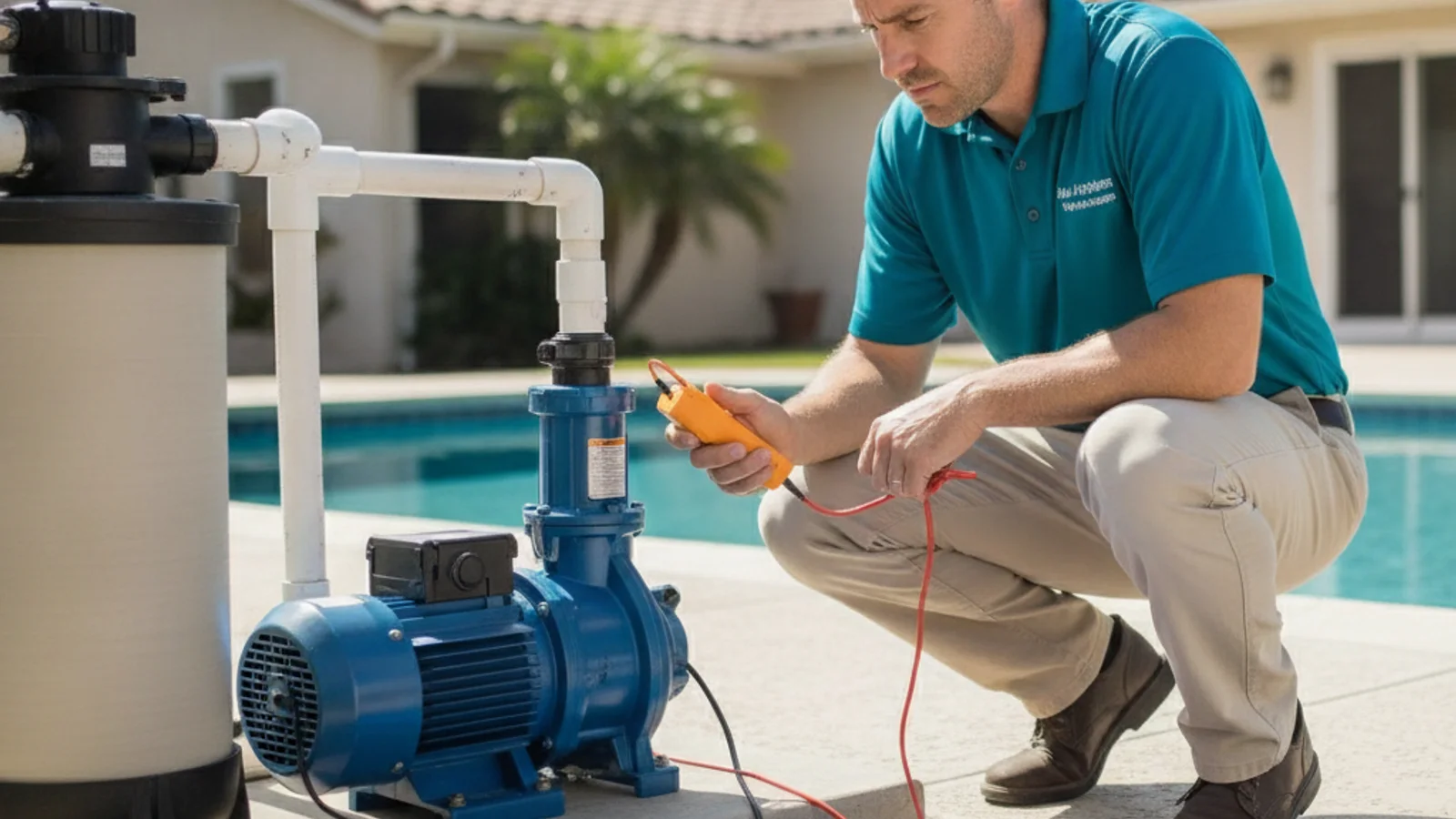
Hayward pool pump repair in San Diego typically costs $150 to $600 for a single-part fix like a shaft seal, capacitor, or bearing set, and $450 to $900 for a full motor replacement. The pump is the single most repaired piece of pool equipment in the county, and most failures fall into one of five categories: leaking seals, dead capacitors, worn bearings, tripped breakers, or a motor that hums but won’t turn. Knowing which one you’re looking at determines whether a licensed pool repair pro fixes it in an hour or recommends replacing the unit outright.
Why do Hayward pumps fail so often in San Diego
Hard water and long run times wear down Hayward pump seals faster here than in most of the country. San Diego County water carries 150 to 300+ parts per million of dissolved minerals depending on the district, and that hardness scales onto the pump’s mechanical seal every time the pool runs. Add nine-plus months of pool season a year, and a Hayward pump here logs far more operating hours than the same model in a shorter-season climate. Coastal zip codes carry a second stressor: salt air corrodes pump housings, unions, and electrical connections faster than inland heat alone would.
What are the five most common Hayward pump problems
The five failures that account for most Hayward pump service calls are a leaking shaft seal, a blown capacitor, worn bearings, a tripped or nuisance-tripping breaker, and a motor that hums without spinning.
Leaking shaft seal. Water pooling under the pump housing, especially right where the motor meets the wet end, points to a worn mechanical seal. This is the single most common Hayward repair call in the network. A pro swaps the seal kit, usually $150 to $300 installed, and the pump runs dry again the same day.
Blown run capacitor. A pump that hums for a second, then shuts off or won’t start at all, often has a failed capacitor rather than a dead motor. Capacitors are cheap parts, generally $80 to $180 installed, but a technician still needs to confirm it’s the capacitor and not the motor windings behind it before replacing anything.
Worn bearings. A grinding or squealing noise that gets louder over days or weeks means the motor bearings are failing. Left alone, worn bearings eventually seize the shaft and take the whole motor with them. Bearing replacement runs $200 to $400 when caught early; ignored, it becomes a $450 to $900 motor swap.
Tripped breaker. A Hayward pump that trips its breaker every time it starts usually has a short somewhere in the motor windings, often from long-term moisture intrusion around a failed seal. This is a case where the seal problem and the electrical problem showed up together, and a repair pro checks both rather than just resetting the breaker and walking away.
Motor hums but won’t spin. If the shaft turns freely by hand but the motor won’t start under power, the start capacitor or the start switch inside the motor housing is the usual suspect. If the shaft won’t turn by hand at all, the bearings have likely seized, which points toward replacement instead of repair.
When does it make sense to repair versus replace a Hayward pump
Repair a Hayward pump under 8 years old with a single-part failure; replace one over 10 to 12 years old or one that’s needed two separate repairs in the same year. A seal, capacitor, or bearing swap on a younger pump is a same-day fix that costs a fraction of a new unit. Once a pump crosses a decade of San Diego run time, the motor windings and internal wiring have usually absorbed enough heat cycles and moisture exposure that a second failure tends to follow within a year or two of the first.
Replacement also makes financial sense earlier than most homeowners expect if the current pump is a single-speed model. Variable-speed Hayward pumps use 60 to 80 percent less electricity than a single-speed pump running the same hours, and San Diego’s tiered electricity rates make that difference add up fast over a pool season that runs nine months or longer.
What does a Hayward pump repair visit actually involve
A repair pro isolates power at the breaker, opens the pump housing, and tests the motor, capacitor, and seal separately before recommending a fix. Diagnosing by ear or by symptom alone leads to swapped parts that don’t solve the actual problem, which is why a proper visit includes pulling the motor and checking winding resistance with a meter, not just listening to the noise it makes. The specialists in our network carry common Hayward parts on the truck, so a seal, capacitor, or bearing repair is usually a single visit rather than a return trip.
If the pump turns out to need a full pool equipment overhaul rather than a single-part fix, that same visit is the right time to look at the filter and heater too, since a system running on a failing pump often has related wear elsewhere. And if the pump failure surfaced because of a bigger issue, like a cracked return line pulling air into the system, a pool leak detection specialist can trace that separately so the new pump isn’t fighting the same problem again in six months.
Does a bad pump ever point to a bigger pool problem
Yes, a pump that keeps losing prime or straining under load sometimes signals suction from a leak elsewhere in the plumbing, not a pump-only failure. Air bubbling from the return jets, a pump that won’t hold prime after priming correctly, or a water level dropping faster than evaporation accounts for are all signs worth a proper pool repair diagnosis before assuming the pump itself is at fault. Chasing pump symptoms without checking the plumbing behind them means paying for a repair that doesn’t actually fix anything.
Homeowners converting to a salt system around the same time as a pump repair should also loop in a salt water conversion specialist, since salt cells and pump sizing interact and it’s worth sequencing that work together rather than paying for two separate service calls.
How fast can a failed pump get fixed in San Diego
Most Hayward pump repairs finish same-day or next-day once a technician diagnoses the failure, since seals, capacitors, and bearings are common stock parts. A pump that’s dead and leaving a pool with no circulation qualifies as an emergency pool situation, especially in summer when algae can take hold within 48 hours of a pump going down. San Diego homeowners from Pool Service in San Diego and surrounding areas can get a same-day repair or replacement quote by calling in.
Frequently asked questions
How much does Hayward pool pump repair cost in San Diego?
Most Hayward pump repairs run $150 to $600, covering labor and a single replaced part like a seal kit, capacitor, or shaft. A full motor swap lands between $450 and $900 installed. A brand-new pump, motor and all, typically runs $700 to $1,400 depending on horsepower and whether it’s variable-speed.
How do I know if my Hayward pump motor is dying versus just needs a seal?
A leaking pump with a quiet motor usually just needs a new shaft seal, a $150 to $300 fix. A motor that hums but won’t spin, trips the breaker, or grinds when you turn the shaft by hand is a motor-level failure that usually calls for a rebuild or replacement, not a seal kit.
Is it cheaper to repair or replace a Hayward pool pump?
If the pump is under 8 years old and the failure is a seal, capacitor, or bearing, repair almost always wins on cost. Once a pump passes the 10 to 12 year mark or needs two separate repairs within a year, a new variable-speed replacement usually pays for itself in electricity savings within 2 to 3 years.
Why does my Hayward pump make a loud grinding or squealing noise?
Grinding almost always means the bearings are worn and metal is contacting metal inside the motor housing. Squealing points to the same bearing wear at an earlier stage, or occasionally a slipping belt on older two-speed models. Either way, running the pump longer turns a bearing job into a full motor replacement.
Can I fix a leaking Hayward pool pump myself?
Swapping a shaft seal is within reach for a confident DIYer with the right seal kit and a few hours, but San Diego’s hard water leaves mineral scale on the seal plate that makes a clean reseat tricky. A pro from Refresh Pool Pros’ network typically finishes the same job in under an hour with a warranty on the part.
How long does a Hayward pool pump usually last in San Diego?
Most Hayward pumps run 8 to 12 years in San Diego before a motor-level failure makes replacement the better call. Coastal salt air corrodes housings and fittings faster in beach-adjacent neighborhoods, while inland heat and hard water accelerate seal and bearing wear, so either end of the county tends to shorten that window slightly.
If your Hayward pump is leaking, tripping breakers, or making a noise that wasn’t there last week, don’t wait for it to seize. Call Refresh Pool Pros at (858) 400-4598 for a same-day repair or replacement quote from a licensed pool repair specialist in our San Diego network.
Frequently asked questions
How much does Hayward pool pump repair cost in San Diego?
Most Hayward pump repairs run $150 to $600, covering labor and a single replaced part like a seal kit, capacitor, or shaft. A full motor swap lands between $450 and $900 installed. A brand-new pump, motor and all, typically runs $700 to $1,400 depending on horsepower and whether it's variable-speed.
How do I know if my Hayward pump motor is dying versus just needs a seal?
A leaking pump with a quiet motor usually just needs a new shaft seal, a $150 to $300 fix. A motor that hums but won't spin, trips the breaker, or grinds when you turn the shaft by hand is a motor-level failure that usually calls for a rebuild or replacement, not a seal kit.
Is it cheaper to repair or replace a Hayward pool pump?
If the pump is under 8 years old and the failure is a seal, capacitor, or bearing, repair almost always wins on cost. Once a pump passes the 10 to 12 year mark or needs two separate repairs within a year, a new variable-speed replacement usually pays for itself in electricity savings within 2 to 3 years.
Why does my Hayward pump make a loud grinding or squealing noise?
Grinding almost always means the bearings are worn and metal is contacting metal inside the motor housing. Squealing points to the same bearing wear at an earlier stage, or occasionally a slipping belt on older two-speed models. Either way, running the pump longer turns a bearing job into a full motor replacement.
Can I fix a leaking Hayward pool pump myself?
Swapping a shaft seal is within reach for a confident DIYer with the right seal kit and a few hours, but San Diego's hard water leaves mineral scale on the seal plate that makes a clean reseat tricky. A pro from Refresh Pool Pros' network typically finishes the same job in under an hour with a warranty on the part.
How long does a Hayward pool pump usually last in San Diego?
Most Hayward pumps run 8 to 12 years in San Diego before a motor-level failure makes replacement the better call. Coastal salt air corrodes housings and fittings faster in beach-adjacent neighborhoods, while inland heat and hard water accelerate seal and bearing wear, so either end of the county tends to shorten that window slightly.
Need professional help in San Diego County?
Refresh Pool Pros provides every service in this post. Call for a free quote.