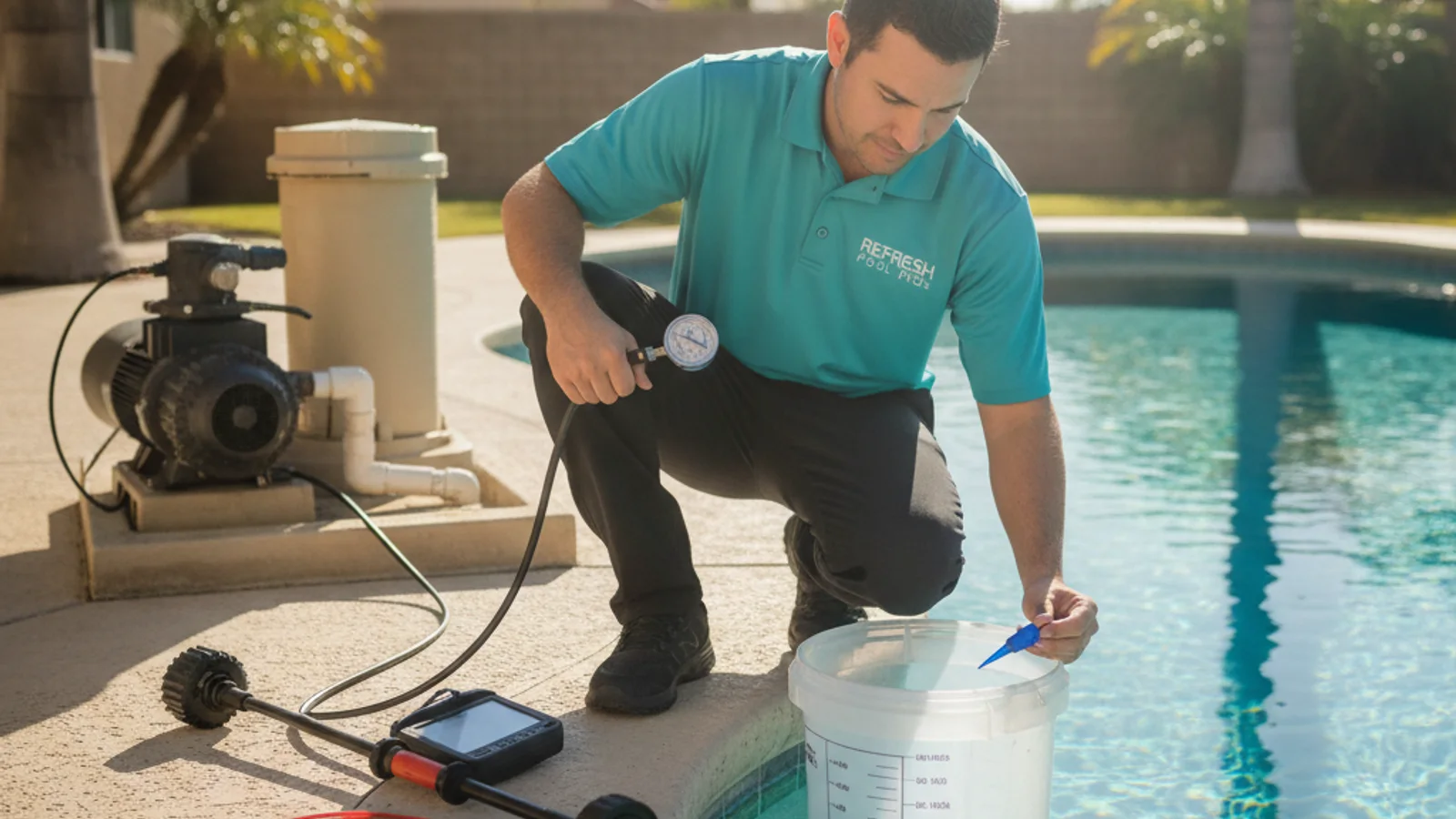
Pool leak detection works by isolating the leak to one of three systems (the shell, the plumbing, or the equipment) through a sequence of pressure tests, dye tests, and electronic listening equipment, then narrowing the location to within a few inches before any repair begins. A licensed pool repair specialist doesn’t guess. They rule systems out one at a time, using tools that measure pressure loss or literally listen for water moving through cracked pipe, until the leak has nowhere left to hide.
How does pool leak detection actually work
Detection starts broad and gets narrower with every test. A technician first confirms real water loss with a bucket test, then splits the investigation into three lanes: the pool shell and fittings, the underground plumbing, and the equipment pad. Each lane gets its own test method. Pressure testing isolates plumbing lines one at a time and watches for pressure drop over several minutes. Dye testing traces visible cracks and suspect fittings by watching how colored dye moves in still water near the spot. Electronic listening equipment picks up the acoustic signature of water escaping under pressure, even through several feet of soil or concrete. Most leaks get confirmed by the second or third test in that sequence.
What is the bucket test and why does every leak check start there
The bucket test confirms whether a pool is actually leaking or just losing water to evaporation, and it’s the first step before any paid diagnostic work. A pro (or a homeowner, before calling one) places a bucket on the pool step filled to the same level as the pool water, marks both waterlines, and checks again 24 hours later. If the pool dropped more than the bucket, water is escaping somewhere beyond normal evaporation. San Diego’s dry air and coastal wind push evaporation losses to a quarter inch to half an inch a day even without a leak, so the bucket test has to run long enough to separate a real leak from a normal water cycle.
How do technicians tell if the leak is in the shell, the plumbing, or the equipment
The pump-on-versus-pump-off comparison is the fastest way to separate a plumbing leak from a shell leak. A technician marks the water level, runs the pump for several hours, then checks the loss again with the pump off overnight. Water loss that only happens with the pump running points to pressurized plumbing, since suction and return lines only carry water under pressure while the system is circulating. Water loss that continues at the same rate whether the pump runs or not usually means the leak is in the shell itself, a skimmer throat, a light niche, or a fitting that stays wet all the time regardless of circulation.
What does pressure testing a pool’s plumbing involve
Pressure testing isolates each plumbing line with a plug and gauge, then pumps the line up to a set pressure and watches whether it holds. A pro caps off one line at a time (skimmer, main drain, each return) at the equipment pad, connects a pressure gauge, and pressurizes the line with air or water. A line that holds steady pressure for several minutes is sound. A line that loses pressure quickly has a break somewhere along its run, and the rate of pressure loss gives the technician a rough sense of how large the crack or separation is. This step is what turns “the plumbing is leaking somewhere” into “the leak is in this specific line.”
How does dye testing pinpoint the exact spot
Dye testing works because water flows toward a leak even in a still pool, and colored dye released near a suspect crack shows that flow visually. Once a technician has narrowed the leak to a general area (a specific fitting, a step crack, a light niche), they turn off the pump so the water sits still, then release a small stream of dye right at the suspected spot with a syringe or squeeze bottle. If dye gets pulled into the crack or fitting, the leak is confirmed at that exact location. Dye testing doesn’t work well for finding a leak from scratch across an entire pool. It works best as the last confirming step after pressure testing or listening equipment has already narrowed things down.
When do pros use electronic listening equipment instead
Electronic listening equipment gets used when a plumbing leak is confirmed by pressure testing but the exact underground location isn’t obvious from the surface. A specialist places a sensitive microphone probe against the ground or on exposed pipe and listens for the specific acoustic signature water makes escaping a pressurized line, a sound distinct from normal background noise. This method can locate a leak several feet underground without digging, which matters in San Diego where mature landscaping, hardscape, and concrete decking often sit directly over pool plumbing. It’s slower and requires more skill to interpret than dye testing, which is why it’s typically reserved for plumbing leaks that pressure testing alone can’t pinpoint.
What happens after the leak is found
Once a leak is pinpointed, the location determines whether it’s a same-day fix or a bigger project. A cracked return fitting or a loose gasket often gets repaired the same visit. A structural leak in the shell, or a plumbing leak that runs under decking, sometimes calls for pool resurfacing work or trenching to access the pipe, which the technician scopes out separately once the source is confirmed. If the leak turns out to be coming from a pump seal or a cracked equipment housing rather than the shell or underground lines, the fix folds into a standard pool equipment repair instead of a leak-specific one.
Pools losing water fast enough to expose the pump to air, or a leak large enough to threaten a retaining wall or nearby structure, count as an emergency pool situation that shouldn’t wait for a scheduled appointment. Homeowners converting to salt at the same time should mention it up front, since a salt water conversion specialist needs to know about an active leak before installing a new cell. Spas and attached hot tubs have their own plumbing loops and get diagnosed separately by a spa hot tub technician, and detached water features run through a fountain service pro instead. For anything beyond the leak diagnosis itself, a full pool repair visit covers the rest of the system.
San Diego homeowners searching for pool service in San Diego can request a leak detection appointment and get matched with a specialist who carries pressure testing and listening equipment on the truck, so the diagnosis and the fix often happen in the same visit.
Frequently asked questions
How long does a pool leak detection visit take?
Most leak detection visits run 1 to 3 hours, depending on how many possible sources the technician has to rule out. A leak confined to one line, like a single cracked return fitting, is usually confirmed within the first hour. A leak that could be structural, in the plumbing, or in the equipment pad takes longer because each system has to be pressure tested separately.
How much does pool leak detection cost in San Diego?
Leak detection alone typically runs $150 to $400 in San Diego, separate from the cost of the actual repair once the leak is found. Some pool repair pros credit that fee toward the repair if you hire them for the fix. Structural leaks that need dive equipment or specialized listening gear can push toward the higher end of that range.
Can a pool leak detection specialist find a leak without draining the pool?
Yes, in most cases. Electronic listening devices, dye testing, and pressure testing all work with the pool full, since the goal is to find where water is escaping under normal operating conditions. Draining is sometimes needed afterward for the repair itself, particularly on structural cracks below the waterline, but not for locating the leak.
What’s the difference between a bucket test and professional leak detection?
A bucket test only tells you whether you have a leak and roughly how much water you’re losing per day. It can’t tell you where the leak is or whether it’s in the shell, the plumbing, or the equipment. Professional detection adds pressure testing and either dye or electronic tracing to pinpoint the exact location so a repair pro fixes the right thing the first time.
Why is my pool losing water if I can’t see any wet spots in the yard?
Underground plumbing leaks often don’t surface as visible wet spots, especially in sandy or fast-draining San Diego soil, because the water disperses before it pools on the surface. A leak in a return or suction line can lose hundreds of gallons a week with no sign in the yard at all, which is exactly the kind of leak pressure testing is built to catch.
How do I know if I have a leak versus just normal evaporation?
Normal evaporation in San Diego runs about a quarter inch to half an inch of water loss per day depending on the season and whether the pool is covered. Losing more than that, especially if the loss continues at the same rate with the pump off, points to an actual leak rather than evaporation.
If your pool is dropping faster than a bucket test says it should, get it diagnosed before the leak turns into a bigger repair. Call Refresh Pool Pros at (858) 400-4598 for a leak detection appointment with a licensed pool repair specialist in our San Diego network.
Frequently asked questions
How long does a pool leak detection visit take?
Most leak detection visits run 1 to 3 hours, depending on how many possible sources the technician has to rule out. A leak confined to one line, like a single cracked return fitting, is usually confirmed within the first hour. A leak that could be structural, in the plumbing, or in the equipment pad takes longer because each system has to be pressure tested separately.
How much does pool leak detection cost in San Diego?
Leak detection alone typically runs $150 to $400 in San Diego, separate from the cost of the actual repair once the leak is found. Some pool repair pros credit that fee toward the repair if you hire them for the fix. Structural leaks that need dive equipment or specialized listening gear can push toward the higher end of that range.
Can a pool leak detection specialist find a leak without draining the pool?
Yes, in most cases. Electronic listening devices, dye testing, and pressure testing all work with the pool full, since the goal is to find where water is escaping under normal operating conditions. Draining is sometimes needed afterward for the repair itself, particularly on structural cracks below the waterline, but not for locating the leak.
What's the difference between a bucket test and professional leak detection?
A bucket test only tells you whether you have a leak and roughly how much water you're losing per day. It can't tell you where the leak is or whether it's in the shell, the plumbing, or the equipment. Professional detection adds pressure testing and either dye or electronic tracing to pinpoint the exact location so a repair pro fixes the right thing the first time.
Why is my pool losing water if I can't see any wet spots in the yard?
Underground plumbing leaks often don't surface as visible wet spots, especially in sandy or fast-draining San Diego soil, because the water disperses before it pools on the surface. A leak in a return or suction line can lose hundreds of gallons a week with no sign in the yard at all, which is exactly the kind of leak pressure testing is built to catch.
How do I know if I have a leak versus just normal evaporation?
Normal evaporation in San Diego runs about a quarter inch to half an inch of water loss per day depending on the season and whether the pool is covered. Losing more than that, especially if the loss continues at the same rate with the pump off, points to an actual leak rather than evaporation.
Need professional help in San Diego County?
Refresh Pool Pros provides every service in this post. Call for a free quote.