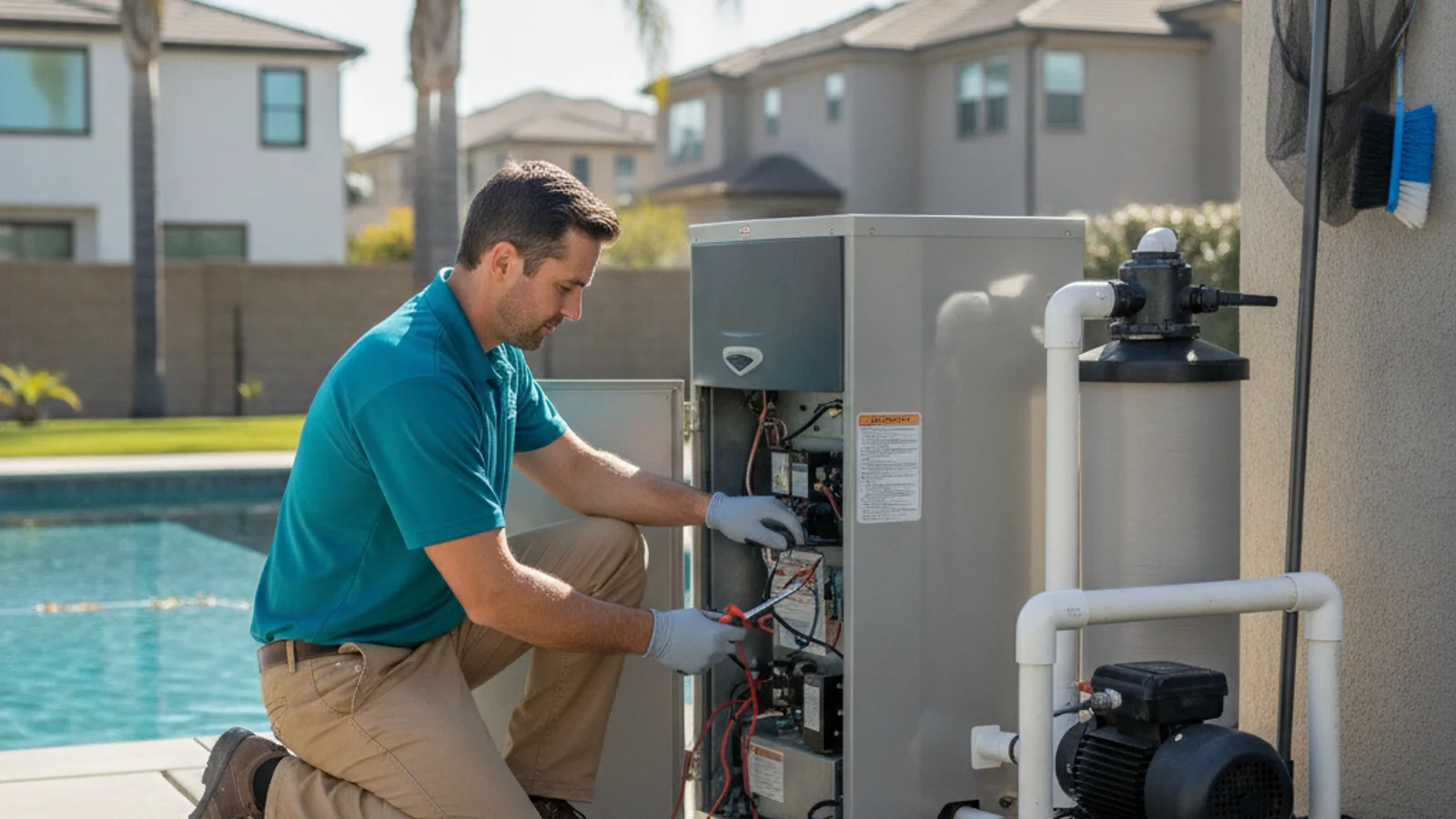
A pool heater that won’t turn on is almost always one of seven things: no power at the breaker, a tripped safety switch, low water flow, a bad ignitor, a closed gas valve, a thermostat set wrong, or a failed control board. Flow and ignition problems account for most service calls in San Diego, largely because equipment pads sit exposed to dust, pollen, and salt air that clog flow switches and foul ignitor components faster than in drier inland climates. Working through the list in order, cheapest and simplest first, solves the problem without paying for a diagnostic visit in most cases.
Why is my pool heater not turning on
A pool heater that won’t turn on is failing at one of three stages: it isn’t getting power, it isn’t getting water flow, or it isn’t getting a spark to ignite the gas. Each stage has its own set of usual suspects, and diagnosing which stage is failing narrows the fix down fast. A heater with a completely dark display points to power. A heater that hums or the pump runs but no flame lights points to ignition. A heater that starts, runs briefly, then shuts off points to a safety switch tripping mid-cycle.
Check the power supply first
No power to the heater is the single easiest fix and the one homeowners skip. Start at the dedicated breaker in the electrical panel, since pool heaters typically run on their own circuit separate from the pump. A tripped breaker that won’t reset, or one that trips again within seconds of resetting, usually means a deeper electrical fault and needs a licensed electrician or pool repair pro rather than repeated resets. Check the GFCI outlet near the equipment pad too, if the heater’s control board runs off a standard outlet rather than hardwired power. San Diego’s coastal humidity corrodes outdoor GFCI outlets faster than inland installations, and a corroded outlet trips without warning.
Is the gas valve actually open
Gas heaters need an open shutoff valve at both the meter and the heater itself, and either one closed stops ignition cold. Homeowners sometimes close the heater’s gas valve at the end of summer and forget to reopen it, which looks exactly like a heater failure the following spring. Confirm the valve handle sits parallel to the gas line, not perpendicular, since perpendicular means closed. If the valve is open and gas smell is present anywhere near the unit, stop and call a professional immediately rather than attempting further troubleshooting.
The flow switch is the most common failure point
A dirty or misaligned flow switch stops more San Diego pool heaters than any other single part. The flow switch tells the heater’s control board that water is actually moving through the heat exchanger before it allows ignition, and it’s a safety feature that prevents the heater from firing dry and cracking the exchanger. Debris in the filter, a partially closed valve on the equipment pad, or a pump running below the flow rate the heater needs will all trip this switch. Cleaning the pump basket and skimmer baskets, then backwashing or cleaning the filter, resolves flow-switch trips more often than any part replacement does. If flow reads normal everywhere else, the switch itself may have failed and needs testing with a multimeter, which is a job for a licensed pool repair specialist.
Why won’t the ignitor spark
A worn or fouled ignitor is the second most common cause after flow problems, especially in gas heaters older than 5 years. The ignitor is a small electrode that generates the spark or glow needed to light the burner tray, and it degrades with every ignition cycle over the heater’s life. Signs of a failing ignitor include repeated clicking with no flame, or a flame that lights briefly then goes out. Coastal salt air corrodes ignitor contacts faster than inland air does, which is one reason coastal San Diego heaters tend to need ignitor service a year or two sooner than heaters in East County or the inland valleys. Ignitor replacement is a straightforward repair for a pool repair pro and typically doesn’t require replacing the whole heater.
Check the thermostat and control board settings
A thermostat set below the current water temperature won’t call for heat at all, which looks identical to a broken heater from the homeowner’s side. Confirm the set temperature is actually above the pool’s current reading, and check that the heater is switched to heat mode rather than off or a filter-only setting on combined systems. Digital control boards on newer heaters sometimes display an error code even when the screen looks blank at first glance, so checking for a faint or flashing code before assuming total failure saves a wasted service call.
What a pressure switch failure looks like
Some heater models use a water pressure switch instead of, or in addition to, a flow switch, and a stuck or miscalibrated pressure switch behaves the same way: the heater won’t fire even with strong water flow present. This failure is harder to diagnose without pressure-testing equipment, since the symptom looks identical to a clogged filter or closed valve from the outside. If flow and filtration all check out clean and the heater still won’t ignite, a pressure switch fault is the next thing a technician checks.
When the heat exchanger has failed
A cracked or corroded heat exchanger sometimes prevents ignition entirely as a safety response, rather than just reducing heating output. This is the most expensive failure on the list and the one most likely to justify weighing repair against replacement, particularly on a heater already past 8 to 10 years old. San Diego’s mineral-heavy tap water in much of the county accelerates scale buildup inside the exchanger over time, which is part of why annual professional inspection catches this before it becomes a full failure.
Repair or replace: what actually makes sense
A single failed part, like an ignitor, flow switch, or control board, is almost always worth repairing on a heater under 8 years old. A heater with a cracked heat exchanger, multiple simultaneous failures, or an age past 10 to 12 years usually costs less over its remaining life to replace outright, since newer units run more efficiently and repeated repairs on an aging unit add up fast. A licensed pool repair specialist in our network can pull the heater’s full diagnostic history during one visit and lay out real numbers for both paths before any work starts.
Refresh Pool Pros connects San Diego homeowners to vetted, licensed pool repair specialists who diagnose heater failures the same day in most cases. If the heater is part of a larger pool equipment issue, or the pad also needs a pump, filter, or salt system looked at, the same visit usually covers it. Homeowners converting to a salt water system should have the heater checked at the same time, since salt cells and gas heaters interact with water chemistry differently than traditional chlorine setups. A heater that keeps tripping on flow issues is sometimes actually a symptom of an undetected leak elsewhere in the system, which is worth ruling out with leak detection before replacing parts that aren’t the real problem. For a spa or hot tub heater showing the same symptoms, the same diagnostic order applies, and our network includes specialists who handle spa and hot tub equipment specifically. Homeowners in Carlsbad and nearby coastal cities can find local scheduling details on our Carlsbad pool service page.
Frequently asked questions
Why is my pool heater not turning on at all?
The most common cause is a safety switch that’s stopped the heater before it can ignite, usually the flow switch, high-limit switch, or pressure switch. A blank or unlit display, no error code, and a heater that never attempts ignition usually point to a power or thermostat issue rather than the gas or ignition system. A pool repair pro can pull the exact fault in under 30 minutes with the right diagnostic tools.
How much does it cost to fix a pool heater that won’t turn on?
Simple fixes like cleaning a flow switch or replacing an ignitor typically run $150 to $400 including labor. A failed heat exchanger or gas valve runs $600 to $1,800 depending on the heater’s age and whether parts are still in production. A full heater replacement for a typical residential gas unit in San Diego runs $2,500 to $4,500 installed.
Can I fix a pool heater ignition problem myself?
Checking the gas shutoff valve, breaker, and thermostat settings is safe for most homeowners to do first. Anything involving the gas line, ignitor assembly, or heat exchanger should go to a licensed pool repair specialist, since gas heaters carry real fire and carbon monoxide risk if a repair is done wrong.
Is it worth repairing an old pool heater or replacing it?
A heater under 8 years old with a single failed part, like an ignitor or flow switch, is almost always worth repairing. A heater past 10 to 12 years old showing a cracked heat exchanger or repeated failures usually costs less over time to replace, especially with newer heaters running more efficiently on San Diego gas rates.
Does cold weather cause pool heaters to stop working in San Diego?
San Diego rarely sees hard freezes, but coastal marine layer mornings and inland winter nights can drop water temperature enough that an undersized or aging heater struggles to keep up, which sometimes looks like a heater that won’t turn on when it’s actually cycling on low output. A pro can check whether the heater is undersized for the pool’s volume.
A pool heater that won’t turn on rarely means the whole unit is dead. Call (858) 400-4598 to get matched with a licensed pool repair specialist for a same-week diagnostic and a straight answer on repair versus replacement.
Frequently asked questions
Why is my pool heater not turning on at all?
The most common cause is a safety switch that's stopped the heater before it can ignite, usually the flow switch, high-limit switch, or pressure switch. A blank or unlit display, no error code, and a heater that never attempts ignition usually point to a power or thermostat issue rather than the gas or ignition system. A pool repair pro can pull the exact fault in under 30 minutes with the right diagnostic tools.
How much does it cost to fix a pool heater that won't turn on?
Simple fixes like cleaning a flow switch or replacing an ignitor typically run $150 to $400 including labor. A failed heat exchanger or gas valve runs $600 to $1,800 depending on the heater's age and whether parts are still in production. A full heater replacement for a typical residential gas unit in San Diego runs $2,500 to $4,500 installed.
Can I fix a pool heater ignition problem myself?
Checking the gas shutoff valve, breaker, and thermostat settings is safe for most homeowners to do first. Anything involving the gas line, ignitor assembly, or heat exchanger should go to a licensed pool repair specialist, since gas heaters carry real fire and carbon monoxide risk if a repair is done wrong.
Is it worth repairing an old pool heater or replacing it?
A heater under 8 years old with a single failed part, like an ignitor or flow switch, is almost always worth repairing. A heater past 10 to 12 years old showing a cracked heat exchanger or repeated failures usually costs less over time to replace, especially with newer heaters running more efficiently on San Diego gas rates.
Does cold weather cause pool heaters to stop working in San Diego?
San Diego rarely sees hard freezes, but coastal marine layer mornings and inland winter nights can drop water temperature enough that an undersized or aging heater struggles to keep up, which sometimes looks like a heater that won't turn on when it's actually cycling on low output. A pro can check whether the heater is undersized for the pool's volume.
Need professional help in San Diego County?
Refresh Pool Pros provides every service in this post. Call for a free quote.