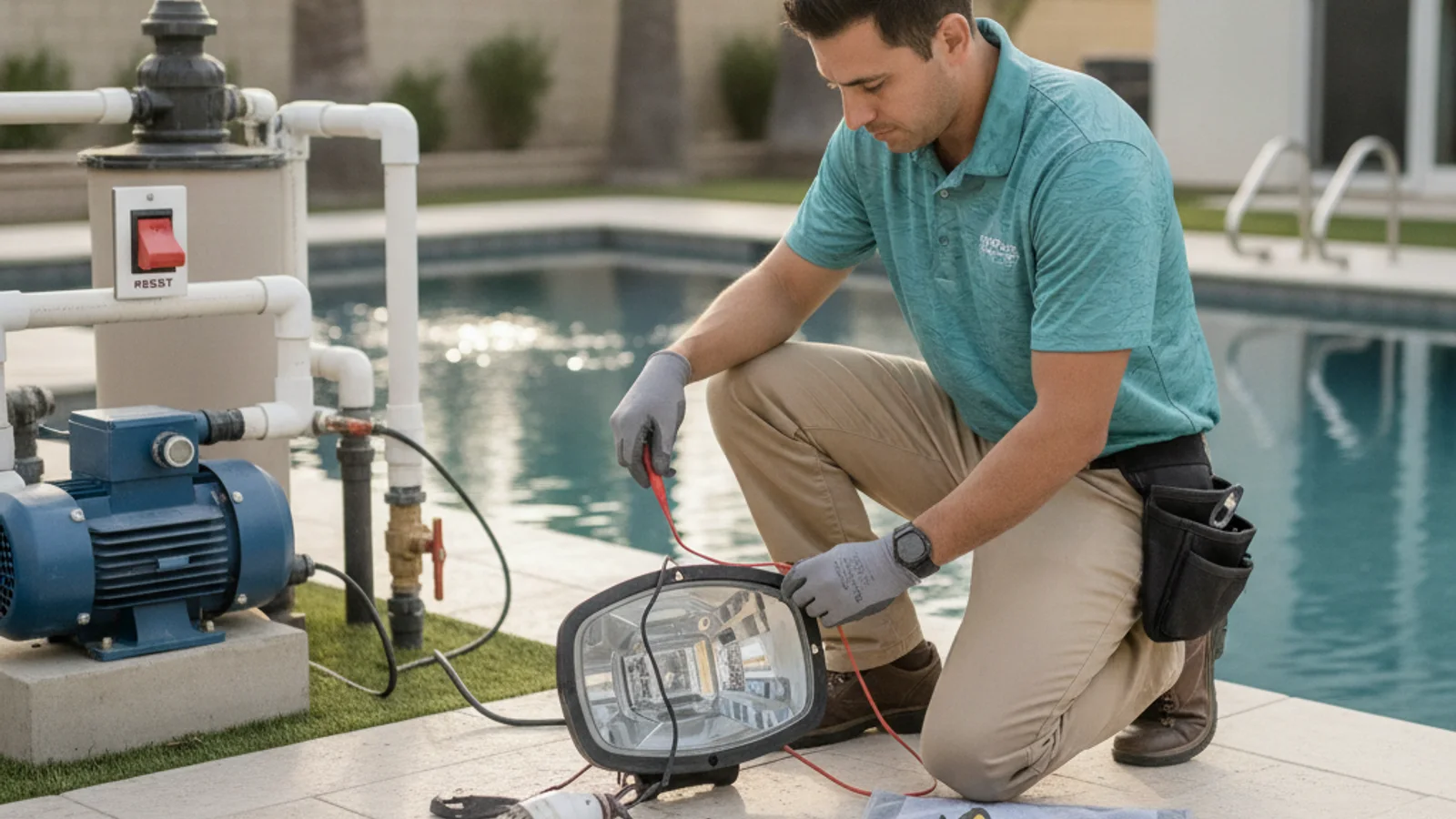
A pool light that won’t turn on is almost always one of three things: a burned-out bulb, a tripped GFCI breaker, or a failed gasket that let water reach the wiring. The first two are quick homeowner checks. The third means the fixture needs to come out and get inspected by a licensed pool electrician before it goes back in the water.
Refresh Pool Pros connects San Diego homeowners with vetted pool repair specialists who handle everything from a five-minute bulb swap to a full niche rewire. This guide walks through how to tell which problem you actually have, what it costs to fix, and when a dark pool light is worth an emergency call instead of a weekend project.
Why is my pool light not working?
Pool lights fail for one of three reasons: the bulb burned out, the circuit lost power, or water got past the seal and into the fixture. Bulb failure is the most common and the cheapest fix, usually under $100 in parts. A tripped GFCI is the second most common and often free to fix once you find the reset button. Water intrusion is the most serious, because it means the gasket has failed and continued use risks damaging the wiring or shocking someone standing in the pool.
How do I check if my pool light bulb is burned out?
Turn off power at the breaker, then pull the fixture out of its niche using the slack in the cord (most pool lights have 15 to 20 feet of cord coiled behind the wall for exactly this). With the light out of the water and the breaker still off, open the lens screws and look at the bulb filament or LED board. A blown incandescent filament will look visibly broken or blackened inside the glass. An LED board that’s dead but shows no burn marks usually means a driver failure rather than the bulb itself, which points toward full fixture replacement instead of a simple bulb swap.
Why does my pool light keep tripping the GFCI?
A pool light circuit that trips the GFCI the moment it’s switched on almost always means moisture has reached a live wire. This happens when the lens gasket dries out, cracks, or was reinstalled slightly off during a past bulb change, letting pool water seep in around the seal. Don’t keep resetting the breaker and flipping the light back on. Every reset is a small test of whether current is finding a path through water instead of the fixture, and a licensed pool electrician needs to pull the light and check both the gasket and the wire nuts in the junction box before it’s safe to run again.
Can pool light problems be an electrical safety issue?
Yes, and this is the one part of pool light troubleshooting where DIY has a real limit. Pool lighting circuits run on a dedicated GFCI specifically because a fixture sitting in water, wired with standard household voltage in many older San Diego pools, is one of the higher-risk points in the whole system. If you see condensation inside the lens, smell anything burnt near the light switch, or the breaker won’t stay reset after two tries, stop and call a specialist. This is different from a routine bulb swap and worth treating as an emergency repair rather than a wait-and-see item.
How much does pool light repair cost in San Diego?
A straightforward bulb and gasket replacement on a light you can access from the niche runs $150 to $350, most of that labor for draining the niche housing and reinstalling the seal correctly. A full fixture swap, including a new cord run back to the junction box, typically costs $400 to $900. Older San Diego pools built before the mid-1990s sometimes still run a 12-volt transformer system rather than a direct 120-volt niche light, and converting one of those over to a modern LED fixture can push toward the higher end of that range because the transformer and wiring path usually need to be redone too.
Should I replace my pool light with LED?
For most San Diego homeowners still running an old incandescent or halogen fixture, switching to LED at the time of repair makes sense. LED pool lights use 70 to 90 percent less energy than incandescent bulbs and last 20,000 to 30,000 hours compared to 1,000 to 2,000 hours for an old-style bulb, so you’re not paying labor again in a year or two. The upfront fixture cost is higher, but if the light is already pulled and the gasket is already being replaced, it’s the point where that upgrade costs the least in labor.
What’s involved in a full pool light replacement?
A full replacement means pulling the old fixture, running new cord through the existing conduit back to a junction box, and setting a new niche gasket before the fixture goes back into the wall. The trickiest part is usually the conduit itself. Pools built in different eras of San Diego’s growth, from 1960s Clairemont builds to newer construction in Rancho Bernardo or Carmel Valley, ran conduit differently, and a specialist needs to confirm the existing path is intact before quoting the job. If the conduit has degraded or was never properly sealed, the fix becomes bigger than a light swap and starts to overlap with broader pool equipment work.
Can a bad pool light point to a bigger leak problem?
Sometimes. A niche that keeps filling with water even after a fresh gasket install can mean the niche housing itself has a crack, which is a job for pool leak detection rather than a lighting fix. This is more common in pools with visible deck cracking nearby or a consistent, unexplained drop in water level. A specialist checking the light should flag this rather than just resealing the same fixture and sending you on your way.
Refresh Pool Pros connects San Diego homeowners with vetted pool repair specialists who diagnose lighting issues correctly the first time, whether that’s a bulb, a gasket, or a full rewire. If your pool is due for a broader refresh, our network also includes pros who handle pool resurfacing and salt water conversion, since lighting work is often bundled with other equipment updates. Homeowners in San Diego and across the county can get matched with a licensed specialist familiar with local code and conduit conventions.
Frequently asked questions
Why did my pool light suddenly stop working?
The most common cause is a burned-out bulb or a tripped GFCI breaker, both of which a homeowner can rule out in under ten minutes. If the light was flickering or dim before it went dark, that points to a failing bulb or a loose niche connection rather than an electrical trip, which usually cuts power instantly with no warning.
Is a pool light that won’t turn on dangerous?
Not on its own, but a light that trips the GFCI repeatedly or shows moisture inside the lens means water has breached the gasket and reached the wiring, which is a real shock hazard. Stop resetting the breaker and have a licensed pool electrician check the niche and junction box before anyone gets back in the water at night.
How much does it cost to fix a pool light in San Diego?
A bulb or gasket swap on an accessible niche runs $150 to $350. A full fixture and cord replacement, or work that requires rewiring back to the junction box, typically runs $400 to $900 depending on how the conduit was originally run and whether the pool has a fiber-optic or older transformer-based system.
Can I replace a pool light bulb myself?
On a standard niche-mounted incandescent or LED fixture, yes, once the breaker is confirmed off and the fixture is pulled up out of the water on its cord. The risk is the gasket: reinstalling it without the exact seal and torque the manufacturer specifies is the single most common reason a DIY bulb swap fails again within a season.
How long do LED pool lights last?
A quality LED pool light lasts 20,000 to 30,000 hours of run time, which works out to roughly 10 to 15 years at typical residential use. Older incandescent or halogen pool bulbs only last 1,000 to 2,000 hours, so if your pool still has the original bulb from a 1990s or early-2000s build, it’s likely just past its natural lifespan.
Why does my pool light keep tripping the breaker?
A GFCI that trips every time the light is switched on almost always means moisture has gotten past the lens gasket and into the fixture or the wiring behind the niche. Repeated trips are the circuit doing its job protecting you from a ground fault, and the fixture needs inspection before it’s forced back on.
If your pool light won’t turn on or keeps tripping the breaker, call Refresh Pool Pros at (858) 400-4598 and get matched with a vetted local specialist for a repair or replacement quote.
Frequently asked questions
Why did my pool light suddenly stop working?
The most common cause is a burned-out bulb or a tripped GFCI breaker, both of which a homeowner can rule out in under ten minutes. If the light was flickering or dim before it went dark, that points to a failing bulb or a loose niche connection rather than an electrical trip, which usually cuts power instantly with no warning.
Is a pool light that won't turn on dangerous?
Not on its own, but a light that trips the GFCI repeatedly or shows moisture inside the lens means water has breached the gasket and reached the wiring, which is a real shock hazard. Stop resetting the breaker and have a licensed pool electrician check the niche and junction box before anyone gets back in the water at night.
How much does it cost to fix a pool light in San Diego?
A bulb or gasket swap on an accessible niche runs $150 to $350. A full fixture and cord replacement, or work that requires rewiring back to the junction box, typically runs $400 to $900 depending on how the conduit was originally run and whether the pool has a fiber-optic or older transformer-based system.
Can I replace a pool light bulb myself?
On a standard niche-mounted incandescent or LED fixture, yes, once the breaker is confirmed off and the fixture is pulled up out of the water on its cord. The risk is the gasket: reinstalling it without the exact seal and torque the manufacturer specifies is the single most common reason a DIY bulb swap fails again within a season.
How long do LED pool lights last?
A quality LED pool light lasts 20,000 to 30,000 hours of run time, which works out to roughly 10 to 15 years at typical residential use. Older incandescent or halogen pool bulbs only last 1,000 to 2,000 hours, so if your pool still has the original bulb from a 1990s or early-2000s build, it's likely just past its natural lifespan.
Why does my pool light keep tripping the breaker?
A GFCI that trips every time the light is switched on almost always means moisture has gotten past the lens gasket and into the fixture or the wiring behind the niche. Repeated trips are the circuit doing its job protecting you from a ground fault, and the fixture needs inspection before it's forced back on.
Need professional help in San Diego County?
Refresh Pool Pros provides every service in this post. Call for a free quote.