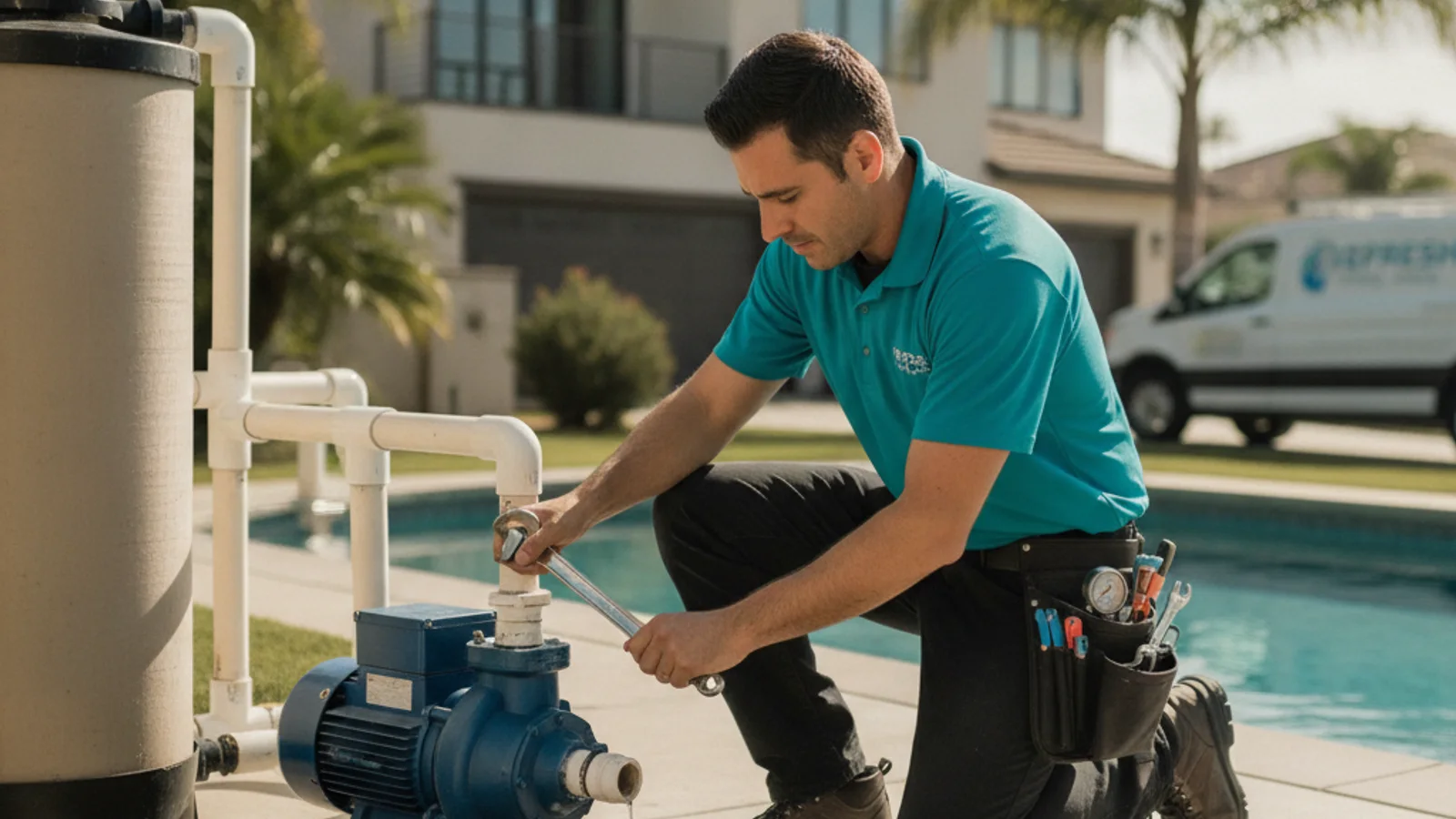
A leaking pool pump almost always traces back to one of three spots: a worn shaft seal where the motor meets the wet end, a cracked or dried-out o-ring under the strainer basket lid, or a loosened union fitting on the intake or return pipe. Shaft seal leaks are the most common of the three and show up as water pooling directly beneath the motor while the pump runs. Catching the source early keeps a $150 seal swap from turning into a $900 motor replacement.
Refresh Pool Pros connects San Diego homeowners with vetted local pool repair specialists who diagnose leaks at the source instead of guessing. This guide walks through where the water is actually coming from, what each cause takes to fix, and when the leak has gone from a minor annoyance to a reason to shut the pump down.
What causes a pool pump to leak water
A pool pump leaks water when a seal, gasket, or fitting that’s supposed to hold pressurized water has worn out, cracked, or loosened enough to let water past it. The pump housing itself rarely fails outright unless it’s cracked from freeze damage or an old plastic housing has gone brittle in the sun, so the leak is almost always a specific component, not the whole unit. Knowing which component narrows the fix from a guess to a five-minute diagnosis.
Where is the water actually coming from
The shaft seal, if water pools directly under the motor
A puddle centered right where the motor housing bolts to the wet end is the shaft seal failing. The seal is a mechanical ring that keeps water in the wet end from reaching the motor while the shaft spins through it thousands of times an hour. San Diego’s hard water leaves mineral scale on the seal’s sealing face faster than it would in softer water, which shortens the seal’s working life to a few years instead of the decade a clean seal can sometimes reach. This is the single most common leak call a licensed pool repair pro gets.
The lid o-ring, if water seeps from the top of the strainer basket
A thin ring of water around the clear lid on top of the pump, especially right after the system starts, usually means the o-ring under that lid has dried out or is missing a coat of lubricant. Sun exposure at an uncovered equipment pad dries out rubber o-rings faster than shade does, which is part of why this fails more often on pads without any overhead cover. This is the cheapest and easiest of the three common leaks to fix.
A union fitting, if water sprays or drips from the pipe connections
The two large plastic collars threaded onto the pipes entering and exiting the pump are unions, and a leak here shows up as a drip or spray right at that joint rather than under the motor. Unions loosen from vibration over years of run time, or the o-ring inside the union wears out the same way the lid o-ring does. A quarter turn with a strap wrench sometimes stops a mild union leak, but a cracked union needs the part replaced.
A cracked housing or drain plug, if the leak is constant even with the pump off
Water present around the pump whether it’s running or not usually points to a cracked housing, a stripped drain plug, or a fitting that’s failed completely rather than just loosened. This is less common than a seal or o-ring leak but tends to mean the part needs full replacement rather than a reseal, since plastic housings don’t patch reliably under pressure.
Can I fix a leaking pool pump myself
A confident DIYer can usually handle an o-ring swap or snugging a loose union, but a shaft seal replacement is a tighter job than it looks. The seal has to seat perfectly flat against a clean sealing surface, and San Diego’s hard water leaves mineral deposits on that surface that make a clean reseat harder than it is in other climates. A pro from the pool repair side of the Refresh Pool Pros network typically finishes a seal swap in under an hour with a warranty on the part, which is worth the cost if the DIY attempt risks a second leak a month later.
What does it cost to fix a leaking pool pump
A shaft seal replacement runs $150 to $300 installed, a lid o-ring or gasket swap is usually $80 to $200, and a union fitting repair lands around $50 to $150 depending on whether the union itself needs replacing. If water has already reached the motor and damaged the windings, the repair becomes a full pump replacement, which runs $600 to $2,200 depending on horsepower and whether you go with a single-speed or variable-speed model. That gap is exactly why catching a leak early matters more than the size of the puddle suggests.
When does a leaking pump become urgent
A leaking pump becomes urgent the moment water reaches the motor housing or the pump starts tripping the breaker. Moisture inside the motor windings creates a short that can destroy the motor within days, and a breaker that trips every time the pump starts is usually telling you that’s already happening. Shut the system off at the breaker and call for a diagnosis rather than resetting it and hoping the leak stays small.
A slow, contained leak away from the motor is safe to run for a day or two while you schedule a repair. Anything spraying, pooling near electrical connections, or paired with a tripping breaker is worth an emergency pool call instead of waiting for a routine appointment.
Does San Diego’s water make pump leaks worse
Yes. San Diego County water carries moderate to very hard mineral content depending on the district, and that hardness scales onto the pump’s shaft seal every time the system circulates. Coastal neighborhoods add a second factor: salt air corrodes metal fittings and housing bolts faster than inland heat alone would, which is part of why beach-adjacent pools tend to see seal and union leaks a year or two sooner than pools further inland. Either way, the fix is the same part, just on a shorter clock.
Get a leak diagnosed before it reaches the motor
Refresh Pool Pros connects San Diego homeowners with vetted pool repair specialists who trace a leak to its actual source instead of swapping parts on a guess. If the pump’s age or run time makes replacement the smarter call, our network also includes pros who handle pool equipment installs and can size a new pump correctly the first time. And if you’ve ruled out the pump but water keeps disappearing from the pool itself, a pool leak detection specialist can trace a leak in the shell or the plumbing lines instead.
Frequently asked questions
Where does water usually leak from on a pool pump?
Most pool pump leaks come from one of three spots: the shaft seal where the motor meets the wet end, the lid o-ring on top of the strainer basket, or a union fitting on the pipes going in and out of the pump. Puddling directly under the motor almost always points to the shaft seal.
Can I keep running a leaking pool pump?
Only for a short window, and only if the leak is small and clearly away from the motor. Water reaching the motor housing can short the windings and turn a $150 seal repair into a $450 to $900 motor replacement, so it’s worth shutting the system down and getting a diagnosis within a day or two.
Is a leaking pool pump an emergency?
It’s rarely a same-hour emergency, but it becomes one fast if water is pooling near the electrical connections or the breaker keeps tripping. A pump that trips a breaker every time it starts has moisture in the motor and should be shut off until a licensed pool repair pro looks at it.
How much does it cost to fix a leaking pool pump?
A shaft seal replacement runs $150 to $300 installed, an o-ring or gasket swap is usually $80 to $200, and a union fitting repair lands around $50 to $150. If the leak has already damaged the motor, a full pump replacement runs $600 to $2,200 depending on the model.
Why is my pool pump leaking only when it’s running?
A leak that only shows up while the pump is on almost always points to the shaft seal or a pressurized union, since both only see water pressure when the system is actively circulating. A leak that’s there even with the pump off usually traces back to a cracked housing or a fitting that’s failed completely.
Can hard water cause a pool pump to leak?
Yes. San Diego County water runs moderate to very hard depending on the district, and mineral scale builds up on the shaft seal’s sealing face over time. That buildup keeps the seal from closing fully, which is why pumps here tend to develop seal leaks a few years sooner than the same model running in softer water.
If your pump is leaking and you’re not sure how bad it is, call Refresh Pool Pros at (858) 400-4598 for a straight diagnosis and a repair quote from a vetted local specialist.
Frequently asked questions
Where does water usually leak from on a pool pump?
Most pool pump leaks come from one of three spots: the shaft seal where the motor meets the wet end, the lid o-ring on top of the strainer basket, or a union fitting on the pipes going in and out of the pump. Puddling directly under the motor almost always points to the shaft seal.
Can I keep running a leaking pool pump?
Only for a short window, and only if the leak is small and clearly away from the motor. Water reaching the motor housing can short the windings and turn a $150 seal repair into a $450 to $900 motor replacement, so it's worth shutting the system down and getting a diagnosis within a day or two.
Is a leaking pool pump an emergency?
It's rarely a same-hour emergency, but it becomes one fast if water is pooling near the electrical connections or the breaker keeps tripping. A pump that trips a breaker every time it starts has moisture in the motor and should be shut off until a licensed pool repair pro looks at it.
How much does it cost to fix a leaking pool pump?
A shaft seal replacement runs $150 to $300 installed, an o-ring or gasket swap is usually $80 to $200, and a union fitting repair lands around $50 to $150. If the leak has already damaged the motor, a full pump replacement runs $600 to $2,200 depending on the model.
Why is my pool pump leaking only when it's running?
A leak that only shows up while the pump is on almost always points to the shaft seal or a pressurized union, since both only see water pressure when the system is actively circulating. A leak that's there even with the pump off usually traces back to a cracked housing or a fitting that's failed completely.
Can hard water cause a pool pump to leak?
Yes. San Diego County water runs moderate to very hard depending on the district, and mineral scale builds up on the shaft seal's sealing face over time. That buildup keeps the seal from closing fully, which is why pumps here tend to develop seal leaks a few years sooner than the same model running in softer water.
Need professional help in San Diego County?
Refresh Pool Pros provides every service in this post. Call for a free quote.